
A failed experiment can still teach us something.
It can rule out an idea. Reveal a measurement problem. Suggest that the thing worth investigating is different from the thing you started with.
Then someone has to decide what to do next.
That step is easy to overlook when we talk about AI in science. We hear about a model proposing a molecule, spotting an unusual pattern, or producing a promising prediction. But a prediction is the beginning of a conversation with the real world. Someone still has to ask the next question and run the next test.
What happens when we connect those steps?
When the system that helps propose an experiment can also help carry it out, examine the result, and choose what to try afterward?
We are beginning to build laboratories that work that way. I think they deserve more attention.
The important part happens after the answer
Picture a team trying to improve a material.
There are several ingredients they could change. They could adjust the proportions, try a different temperature, or alter how the material is prepared. Each possibility requires work, and some combinations will be a waste of time.
The team needs a way to decide which experiment is worth doing next.
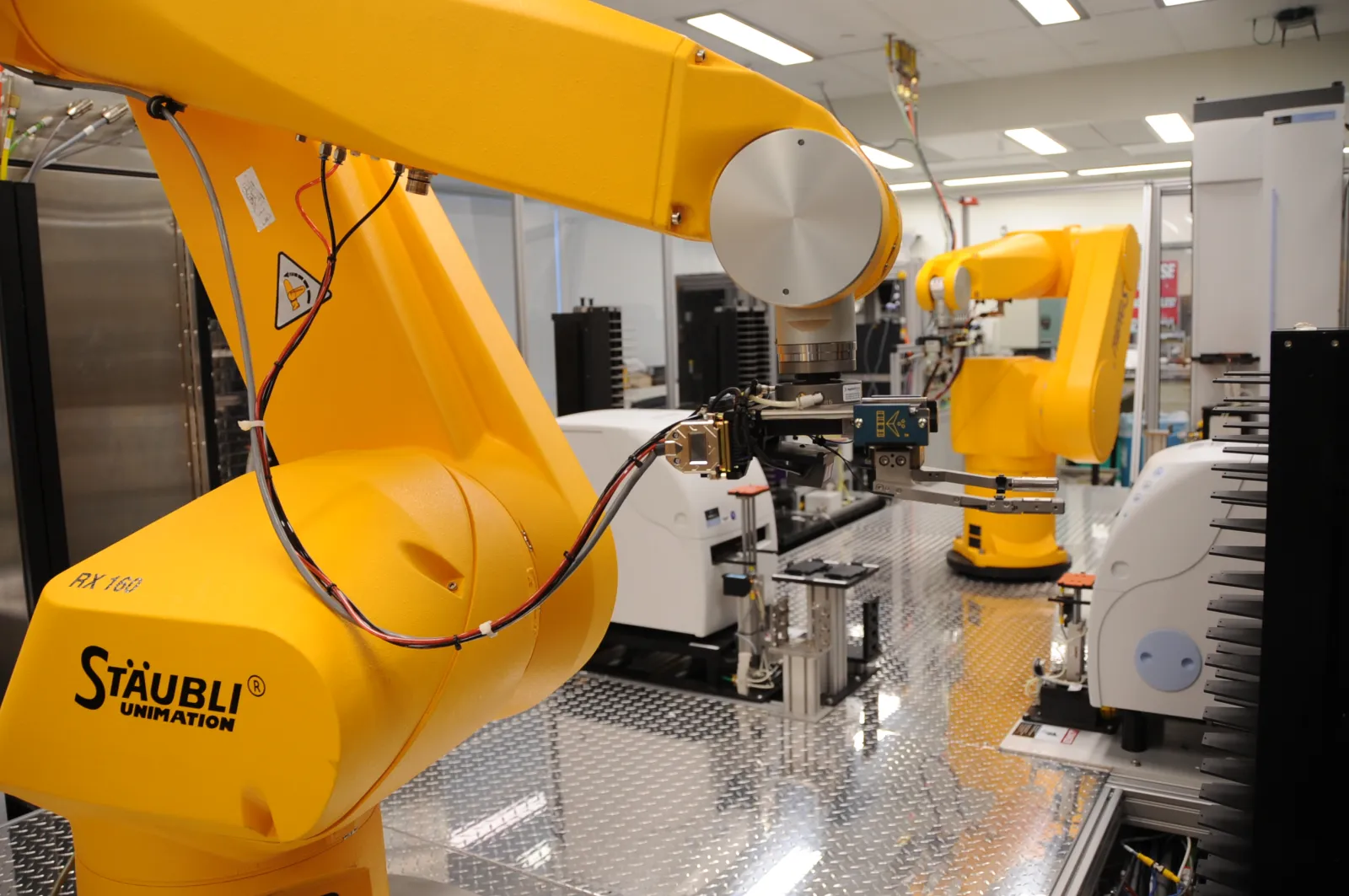
Now imagine a system that keeps a record of what has already been tried, uses those results to propose another test, sends the instructions to laboratory equipment, and examines the new measurements.
The next experiment depends on what happened in the previous one.
That is the basic idea behind a closed-loop laboratory. The phrase sounds more complicated than the idea: the results feed back into the decisions.
The scientists still have to define the problem, build the system, decide what to measure, and establish what the equipment is allowed to do. Within those boundaries, more of the routine cycle can continue without waiting for a person to coordinate every step.
A robot was already doing this in 2020
In a study published in Nature in 2020, researchers used a mobile robot to search for improved mixtures for producing hydrogen from water using light.
Over eight days, it carried out 688 experiments. Its search identified mixtures that were six times more active than the initial formulations.
Those numbers describe a particular experiment with a particular starting point. They do not mean the robot made all chemistry six times better.
But look at what the machine was doing. It was moving through a laboratory, operating equipment, gathering measurements, and using a search algorithm to decide which combinations to investigate.
This was before the current wave of conversational AI. The system used an established statistical approach to guide its search.
That history matters. The laboratory of the future is being assembled from years of work in robotics, instruments, software, and experimental design. New AI capabilities are arriving in a field that has already been building the other pieces.
The pieces are coming together
A 2023 Nature paper described Coscientist, a system that connected a large language model to tools for searching information, writing code, and operating experimental equipment.
The researchers demonstrated it on a defined set of chemical tasks, including planning and optimizing reactions. That gave them a way to investigate how language-based AI could participate in the experimental process.
Then a 2025 biotechnology study described a laboratory system connecting sample handling, culturing, measurement, analysis, and the proposal of new experimental conditions. Its demonstration focused on improving growth conditions for an engineered bacterial strain.
These systems differ in their capabilities and their level of human involvement. None establishes that an AI can walk into an arbitrary laboratory and conduct science on its own.
What they show is more concrete. We can connect parts of scientific work that have often required repeated handoffs between people, software, and equipment.
There is a real engineering problem here, and researchers are working through it.

Biology gets a vote
Anyone who works with software becomes accustomed to a useful luxury. Often, you can change something, run a test, and get an answer quickly.
Physical experiments have their own terms.
Cells need time to grow. Instruments need calibration. A contaminated sample can undermine an otherwise sensible experiment. Two measurements can disagree for reasons the model does not understand.
More capable AI does not make those problems disappear. It could help us notice and manage some of them, but only if the system is designed to recognize when its information is unreliable.
Imagine a laboratory that becomes extremely good at improving a score because the instrument producing that score is faulty. It could run faster, become more confident, and move steadily away from the result anyone actually wanted.
That is a hypothetical failure, but it illustrates why measurement belongs at the center of this discussion.
In The Verification Age, I wrote about the importance of knowing whether an answer deserves our trust. In a laboratory, that question becomes physical. What happened in the sample? Did the measurement capture it? Can someone else reproduce the result?
A faster lab could ask different questions
The possibility that interests me is what happens to the work that rarely gets attempted.
A team might have time to investigate more combinations. It might repeat an important result under different conditions. It might follow an unexpected observation far enough to discover whether it matters.
Those are possibilities, not guaranteed outcomes. Equipment costs money. Samples and supplies cost money. Maintaining an automated system takes expertise. A faster instrument can simply move the bottleneck somewhere else.
But if the complete cycle becomes more dependable and less expensive, the decision about what is worth investigating could change.
A question that once looked too laborious might become manageable. A useful check that would have been postponed might happen routinely.
For medicine, that would still be several steps away from helping a patient. Better laboratory evidence has to lead to a useful intervention, and treatments still need appropriate testing in people.
For materials, energy, and manufacturing, the questions will be different. The underlying opportunity is similar: improve our ability to try something, learn from it, and make a better next decision.
Someone still has to choose what matters
There is another question we should ask before celebrating how many experiments a system can run.
Who gets to use it?
If better laboratories become available only to the organizations that already have the most resources, their benefits will follow that pattern. Shared facilities, accessible tools, and ways for smaller research teams to participate will matter.
So will the objectives we give these systems.
A beautifully automated process can spend years optimizing something of little importance. A less impressive system aimed at an important question could be far more valuable.
The human work includes deciding which problems deserve attention, which risks are acceptable, and what would count as a meaningful result.
That is part of the infrastructure I have been writing about in The Age of Imagineering. Intelligence needs a reliable way to act, measure, and learn.
More chances to find something useful
The most compelling laboratory of the future may look fairly ordinary.
Some equipment. Carefully handled samples. Measurements that can be checked. A record of what happened and why the next experiment was chosen.
Its importance will come from what that arrangement makes possible.
More good questions receiving a serious test. More mistakes caught early. More opportunities to discover that an assumption was wrong.
In my essay about medicine, I wrote about the distance between a scientist’s hunch and finding out whether it could help someone.
A lab that learns could shorten parts of that distance.
It will still have to earn our trust, one result at a time.
What scientific question would you most want a faster lab to investigate?

AI engineer, builder, and author of The Age of Imagineering.