
Imagine you’ve found a place to live. You’ve walked through the rooms, pictured your furniture, figured out the commute. You’ve submitted the application.
Now you wait.
Somewhere, information has to be checked. Someone has to review it. A decision has to move through a system before you can move forward with your life.
That ordinary experience came to mind while watching a recent presentation by Blackstone’s Jon Gray. Among the investment figures was a detail about Tricon, a rental housing company: Blackstone reported that AI was helping it process applications 90% faster. It also reported that Phoenix Tower was processing leases five times faster.
These are Blackstone’s reported results from selected businesses. They don’t establish what every company should expect, or how much sooner a renter actually receives the keys. But they open a question I think deserves much more attention.
When the work gets dramatically faster, what changes for the person waiting on it?
The answer takes us into some uncomfortable territory: what businesses sell, what expertise is worth, and what we decide to do with time we no longer have to spend.
We got used to buying time
For much of professional life, time has been a practical way to put a price on work.
A specialist spends hours understanding a problem. A team spends weeks implementing a system. A company buys software licenses for the people doing the work. Effort, headcount, and elapsed time become familiar parts of the commercial arrangement.
There are good reasons for that. Difficult problems consume attention. Expertise takes years to develop. The scope of a project is sometimes impossible to know before you begin.
But the customer usually has something more specific in mind. They want a contract they understand. Accounts they can trust. A system that works. A problem that stops interrupting their day.
In The Age of Imagineering, I wrote about the shrinking distance between an idea and its execution. Follow that idea into a business and the implications become very practical. If producing a useful result requires much less effort, how should the business change around it?
Before we get to what it should charge, there is another problem to solve.
The work can get faster while almost everything around it stays slow.
Ten minutes of work. Three days of waiting.
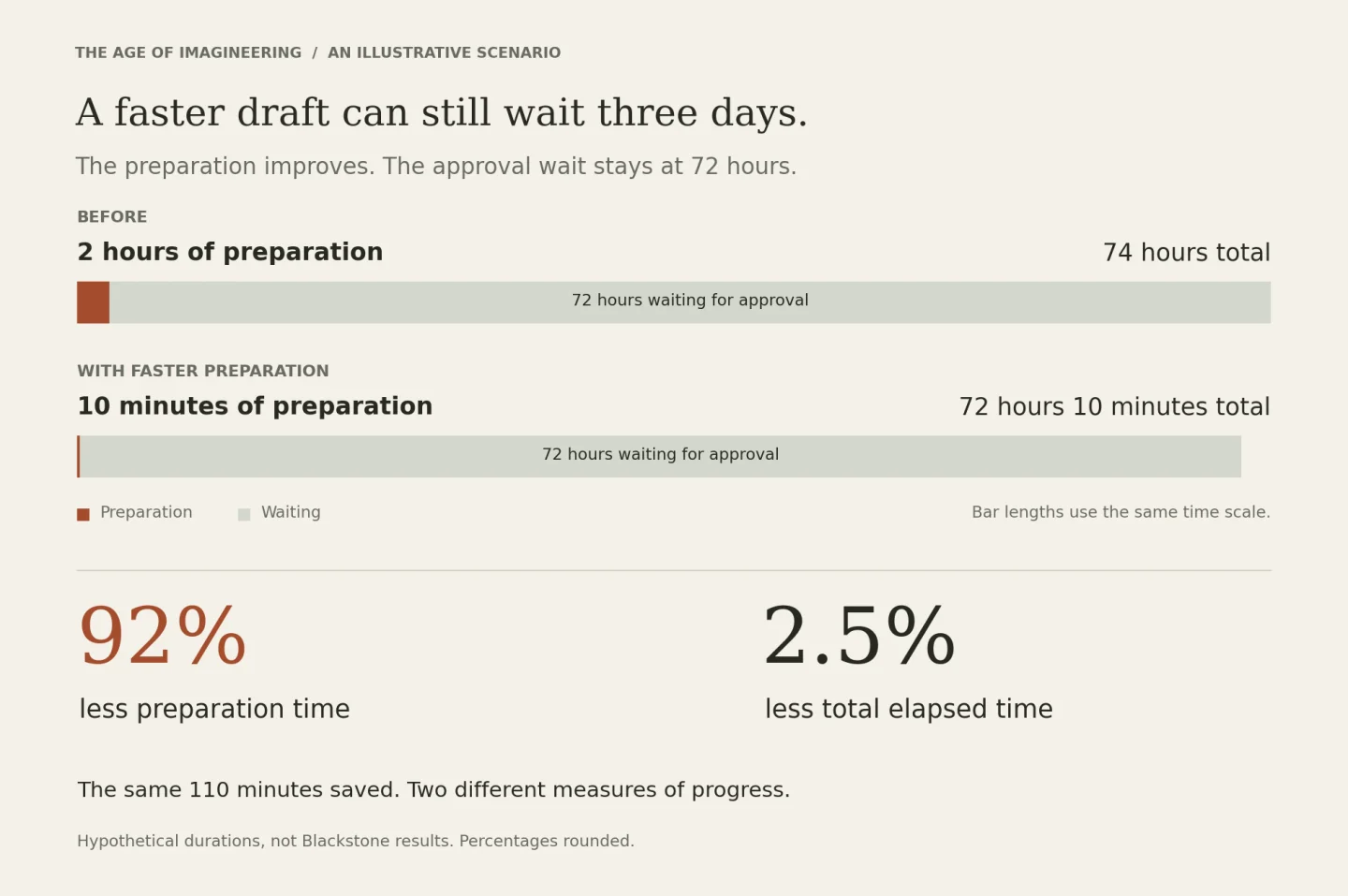
Imagine a report that takes two hours to prepare and then waits three days for approval. Now AI helps someone prepare it in ten minutes. The approval process stays exactly the same.
Preparation time has fallen by about 92 percent. Total elapsed time has fallen by about 2.5 percent.
The person producing the report has experienced a remarkable improvement. The person waiting for the decision may barely notice.
This is where AI adoption starts becoming organizational redesign. Who can make the decision? Which checks genuinely protect the customer? Which steps repeat information someone else has already verified? Where does responsibility become so unclear that everyone waits for someone else?
Some delays are necessary. A serious review takes attention, and some decisions deserve time. We should be able to explain what that time is accomplishing.
The infrastructure for turning intent into outcomes includes permissions, context, and verification. Inside a company, it also includes a very ordinary question: who is allowed to say yes?
A faster tool gives us a reason to look closely at the whole journey. Otherwise, we may simply deliver work to the same queue sooner.
Twenty years of experience can show up in ten minutes
There is a personal side to this that deserves some care.
If you spent decades becoming good at your profession, watching a machine produce a plausible version of your work in seconds can feel unsettling. Part of your identity may be tied to being the person who knows how to do it.
But consider what an experienced person actually contributes. They recognize that the client has described a symptom. They notice the assumption that makes the recommendation fall apart. They know which exception matters and when a confident answer needs another look.
AI can help generate the work. Someone still has to establish whether it solves the right problem and meets the required standard.
That is the distinction I explored in The Verification Age. A convincing output becomes valuable when we have good reasons to rely on it. As production gets easier, understanding and demonstrating those reasons becomes a larger part of the job.
Twenty years of experience may be precisely what makes ten minutes enough.
That won’t protect every task or every role. It does suggest that counting hours will tell us less about someone’s contribution in certain kinds of work.
It also creates a responsibility to the people coming next. If AI performs more of the routine work through which beginners once developed judgment, companies need deliberate ways to help them learn. The question I raised in my essay on education and AI follows us into the workplace: which parts of the struggle build understanding, and which parts can we usefully remove?
We’ll need capable people to judge the work long after we’ve made producing it easier.
What would you sell if the clock stopped?
Around 26 minutes into his presentation, Gray describes companies whose management teams change their model from seats to outcomes.
That is a short observation with a long list of consequences.
Imagine a customer buying a completed reconciliation that meets agreed standards, or a support issue resolved well enough that it stays resolved. The commercial relationship starts to revolve around a result the customer can recognize.
The provider has an incentive to improve how it delivers that result. The customer has a clearer reason to care about the improvement.
But outcome pricing needs careful design. What counts as resolved? What quality is acceptable? What happens when the result depends on something outside the provider’s control? A closed support ticket is easy to count. A customer whose problem has actually been fixed is a more demanding standard.
Hours, subscriptions, fixed fees, and combinations of those arrangements will still make sense in different situations. The useful exercise is to ask what each arrangement rewards.
Does becoming more efficient help both sides? Can the customer tell whether they received good work? Who carries the cost when the answer is wrong?
Those questions become much harder to leave unexamined when the time required to produce the work changes substantially.
A cheaper task can create a larger ambition
There is an opportunity here that gets lost when every discussion ends with reducing headcount.
Consider a small business that can afford only occasional help understanding its finances. Suppose lower delivery costs made frequent, reliable support affordable. The owner might catch a cash-flow problem earlier, make a better hiring decision, or finally understand which work is profitable.
The improvement would include decisions that previously received very little support at all.
Or imagine a team with a long list of useful ideas that never survived the budget discussion. If testing an idea becomes less expensive, more of those ideas can get a fair hearing. A company might serve a group of customers it previously couldn’t reach economically.
This is part of why I remain so excited about AI. Lowering the effort required to do useful work can expand the amount of useful work worth attempting.
That possibility still has costs. Integration, computing, review, maintenance, and correcting mistakes all belong in the calculation. We have to measure what it takes to deliver a result people can depend on.
But once we establish that the improvement is real, we face a much more interesting decision.
What will we do with it?
Who gets the hours back?
Saved effort can take several different paths.
A business can retain more profit. It can lower prices, invest in a better service, expand into a new market, or give its people room to tackle problems they never had time to address. It can also eliminate roles or expect the remaining team to produce more.
The technology doesn’t choose how those gains are shared.
This matters for the people being asked to adopt it. Imagine an employee who finds a way to complete a recurring task in a quarter of the time. What happens next? Do they gain the opportunity to contribute more meaningfully? Does anyone recognize the improvement? Do they worry that explaining it will put their job at risk?
An organization’s answer will say a great deal about whether people feel able to participate honestly in redesigning their work.
And outside the organization, customers have their own version of the question. Does the service become more affordable? Does it become easier to use? Can they get a reliable answer sooner?
I keep returning to the kind of abundance I actually want: more room for people to live, make plans, and act on their ideas. Better productivity gives us more capacity to work toward that. Turning capacity into a better life still requires choices.
Follow the improvement all the way to a person
If I were choosing where to begin, I’d start with one complete experience: from the moment someone asks for help to the moment their problem is actually resolved.
Measure how long it takes, what it costs to deliver, how often it needs correction, and what the person receiving it thinks. Then examine what changes when AI becomes part of the process.
That creates a more useful ambition than simply getting everyone to use a new tool. A team can see where the benefit arrives, where it gets stuck, and what it needs to change next.
The clock matters. So do quality, trust, and the ability to reach someone accountable when things go wrong.
For the person waiting on that rental application, the meaningful moment is getting an answer they can act on. For a business owner, it might be understanding a decision before the opportunity passes. For an employee, it might be finally having room to do the work that drew them to the profession.
We are paying for good judgment, dependable execution, and something in our lives getting better. As AI changes how those things are delivered, we have an opportunity to reconsider the arrangements around them.
We can start by following the gain all the way through.
When the work takes minutes, I want the person on the other side to feel the difference.
Source: Blackstone’s Jon Gray, “Where’s the Beef?” — September 2026 presentation. Business performance figures above are attributed to Blackstone; the report-and-approval example is illustrative.

AI engineer, builder, and author of The Age of Imagineering.